
TOD Preemption Passes the Legislature
Written by Nick Finio, Associate Director of the National Center for Smart Growth and Associate Research Professor at the University of Maryland, and Natalie Roach, Policy Associate at the National Center for Smart Growth.
~
At the close of the 2026 legislative session, the Maryland legislature passed the Transit and Housing Opportunity Act (HB 894). This bill was one of several successful elements of Gov. Moore’s housing package, and other pro-housing bills passed this year.
The Transit and Housing Opportunity Act has several main components which will impact the future of transit-oriented development across the state. With the bill, the state government wrests control over some aspects of land use from local governments near certain rail transit stations. Specifically, all WMATA heavy rail lines in MD, the MTA Purple Line, the Baltimore/MTA Light Rail and Metro, and the MARC Penn (between New Carrollton and Baltimore Penn Station) line are impacted. These lines are identified via a provision that a rail transit station must receive at least hourly service on average between 8am and 6pm on weekdays. Conceivably, in the future, other rail transit lines with currently less frequent service (e.g. the MARC Camden Line) could have frequency upgraded, and therefore be impacted by the bill.
Parking Minimums
The Act preempts local control of off-street parking requirements near rail transit by banning them in certain circumstances. Specifically, off-street parking minimums are now banned in new residential and mixed-use developments within 0.25 miles of rail stations. There is an exception carved out to this if the local government has performed a parking study.
Mixed-Use Development
In perhaps the most striking piece of the legislation, the state Act has preempted some local control of land use within one half mile of a rail station. Zoning regulations within the half mile buffer now “shall allow mixed-use development on land designated for residential use or appropriate commercial use for mixed-use development.” This preemption is designed to catalyze development of mixed-use development, which the bill defines as “any combination of a residential use with a recreational, office, dining, or retail use.”
The Act notably exempts areas currently zoned as single-family residential. Despite this exemption, the Act will impact numerous parcels currently zoned for only multifamily residential use near transit stations throughout the State. The Act will also impact any parcels currently zoned for light-industrial uses.
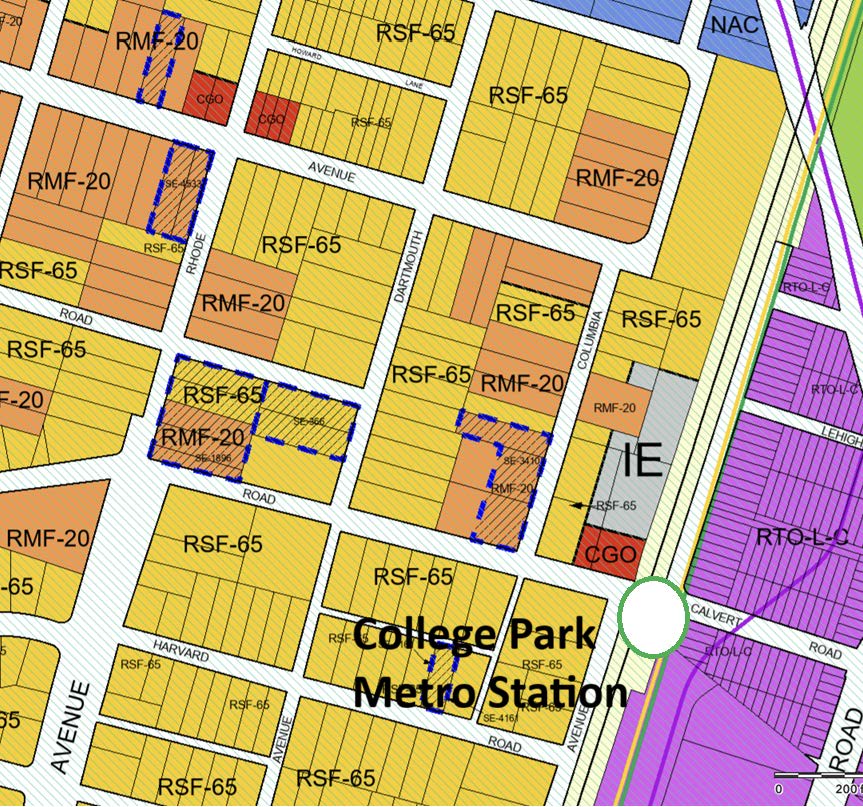
For example, near the University of Maryland, the City of College Park in Prince George’s County has numerous residential parcels zoned RMF-20 within the ½ mile buffer of the College Park Metro station on the green line. This zoning currently only allows residential multifamily development. Density, setbacks, and other regulations on new development on these parcels is still controlled by Prince George’s County, but any new development must allow a mix of residential and commercial uses. Conceivably, small apartment buildings on these lots could now have ground floor shops and restaurants in future development or redevelopment scenarios.
State-Owned Land
The Act also treats certain parcels of state-owned, and WMATA-owned, land that are “contiguous” to rail transit stations uniquely. The parcels must currently be “in use for a transportation purpose,” which we interpret to include parking lots, roads, kiss-and-ride lots, and potentially other uses. On these parcels, local governments may not impose any limitations or restrictions on land use classifications (e.g. zoning). Further, local governments cannot impose any restrictions on height or setbacks (or any “similar requirements” per the bill) for new developments. These provisions are subject to one caveat: the land and development project must be part of an approved transit-oriented development plan coordinated by MDOT and the local government.
For example, WMATA owns several parcels immediately contiguous to the Shady Grove WMATA station on the Red Line in Montgomery County. These parcels have existing height and other requirements that are set by the County’s zoning code, which could now potentially be overridden, underneath a new TOD plan for the area. Numerous other examples exist at rail stations across the state – either on WMATA owned or State-owned land. To understand how this framework could be applied across the state, look to the recent efforts by MDOT to develop a TOD strategy for Baltimore and a specific metro station parking lot in Baltimore City.
TOD Designation
HB 894 also continues to build out the newly updated Maryland transit-oriented development (TOD) designation process. In 2023, the Equitable and Inclusive Transit-Oriented Development Enhancement Act (HB12/SB151) launched the new process for TOD Designation. This included establishing an online application process, a 10 year expiration date on TOD designated sites, and making the Sustainable Growth Subcabinet responsible for issuing approvals. HB12 kickstarted a new focus on TOD designation at the state level. HB 894 expands the benefits of designation; with this Act, sites designated under the program (that meet specific requirements) are automatically considered Enterprise Zones.
The TOD designation is a valuable tool for growing a transit-oriented community. The goal of the program is to facilitate transit-oriented development in key areas and reward localities that are working to advance TOD. When a site is given a TOD designation, it gains access to MDOT’s TOD Capital Grant and Revolving Loan Fund. It also gives projects within site boundaries priority in state applications; the Low Income Housing Tax Credit program under the Maryland Department of Housing and Community Development’s (DHCD) and requests to lease or purchase office or laboratory space with the Department of General Services and MDOT both rewards extra points to applications within TOD designated sites.
There are currently 18 TOD designated sites in the state of Maryland. This updated process will allow for a new wave of locations across the state to be designated as TOD sites and receive the consequent benefits. There are many communities near transit that would benefit from a TOD designation. For example, only one station along the incoming Purple Line – New Carrollton – has received a state TOD designation. As the Purple Line brings changes to the neighborhoods it runs through, access to additional funding and prioritization from the state would allow localities to ensure benefits for Purple Line communities and to work towards an equitable, multimodal future.
Conclusion
In one fell swoop, the state legislature and governor have dramatically increased the potential for TOD near rail transit across the state. In future work, NCSG hopes to quantify the potential impacts of this bill. You can explore how this bill will potentially impact land across the state, especially state owned land, via NCSG’s web mapping tool that was released in 2025.